
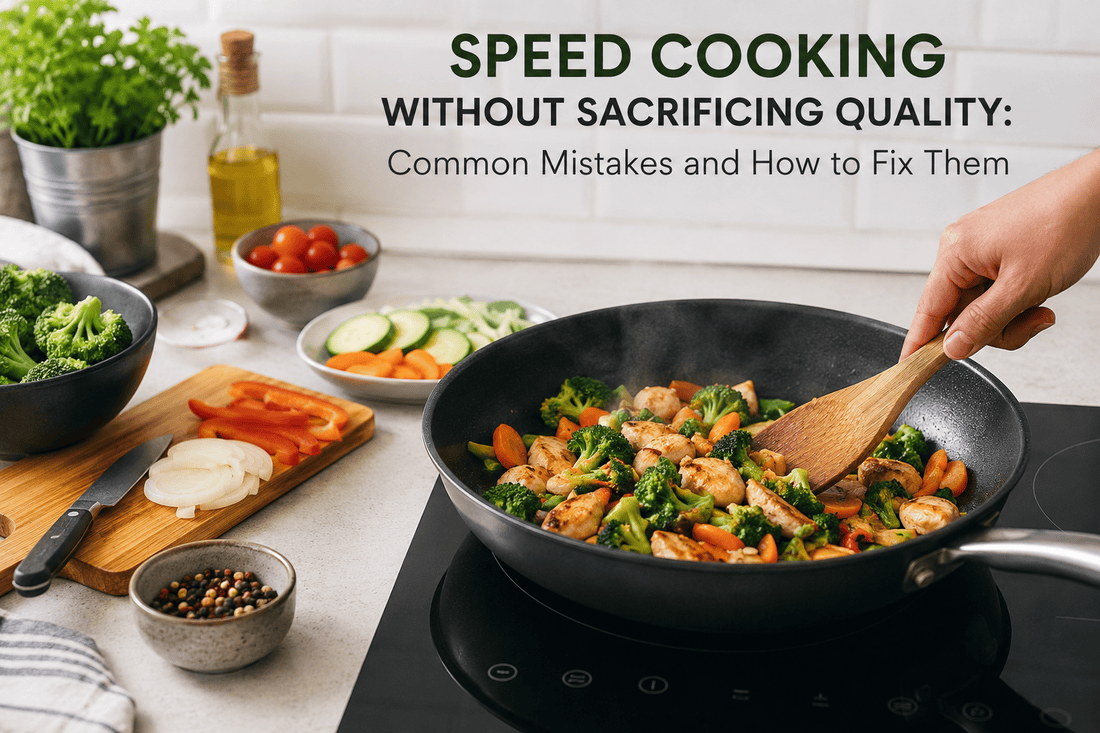
The rush-hour fixes that save dinner without ruining it — what actually works and what backfires every time.
My kitchen has a clock on the wall that I installed specifically because I kept burning garlic. Not because I forgot about it — because I thought I was moving fast enough. I would throw oil in a screaming-hot pan, toss in minced garlic, and turn away for fifteen seconds to grab the next ingredient. By the time I looked back, the garlic was black and bitter, and the whole dish was ruined. That clock now stares at me every evening, reminding me that speed without awareness is just a faster way to fail.
I have been cooking dinner in under thirty minutes for five years. Not because I am particularly talented, but because I have made every mistake a person can make while trying to cook quickly. I have served raw chicken, mushy pasta, and vegetables so overcooked they dissolved into the sauce. Each disaster taught me something specific about what “fast cooking” actually means. It does not mean cooking at maximum heat and hoping for the best. It means eliminating wasted motion, understanding which shortcuts work, and knowing which ones will destroy your meal.
This article is a collection of those lessons. The mistakes are real. The fixes are tested. And the goal is simple: get dinner on the table quickly without apologising for how it tastes.
Mistake #1: Cranking the Heat to Maximum
This is the first instinct of every person who is running late and hungry. The pan goes on the stove, the dial goes to high, and two minutes later the oil is smoking and the kitchen smells like a chemistry experiment gone wrong. High heat has its place — searing a steak, stir-frying in a wok, or boiling water. But for most everyday cooking, maximum heat is a shortcut to disaster.
Food cooks from the outside in. At maximum heat, the exterior burns before the interior is cooked through. Garlic turns bitter in under thirty seconds. Onions char instead of caramelising. Chicken develops a beautiful brown crust over raw, pink flesh. You end up with a dish that looks done but tastes burnt and undercooked at the same time.
Use medium-high heat for most sautéing and pan-cooking. Preheat the pan for two to three minutes before adding oil. The pan should be hot enough that a drop of water sizzles and evaporates immediately — this is called the ‘Leidenfrost point’, around 375°F. But the oil itself should shimmer, not smoke. If it smokes, it is too hot. Remove the pan from heat for thirty seconds, then proceed. Your food will cook more evenly, and you will have time to think instead of panic.
Mistake #2: Cooking Everything at Once
When you are in a hurry, the temptation is to dump every ingredient into the pan simultaneously. The onion, the garlic, the chicken, the vegetables — everything goes in together, and you stir frantically hoping it will all work out. It will not. What happens instead is that the pan temperature drops dramatically, the food starts steaming in its own juices instead of browning, and you end up with a soggy, grey mess that takes twice as long to cook.
Cook in batches. For a standard twelve-inch skillet, never fill more than half the surface area with food at one time. If you are cooking for four people, cook the protein first, remove it, then cook the vegetables in the same pan. The protein rests while the vegetables cook, and everything finishes at the same time. Yes, it takes two pans’ worth of cooking in one pan. No, it does not take longer. It takes less time because each batch cooks properly instead of simmering in its own moisture.
Mistake #3: Skipping the Prep Step
This was my biggest weakness for years. I would start cooking with the vague idea that I would chop vegetables as I went. The onion would go in, and while it softened, I would chop the garlic. While the garlic cooked, I would cut the peppers. Inevitably, something would burn while my attention was on the cutting board. Or I would realise I needed an ingredient I did not have. Or I would cut myself because I was rushing with a sharp knife while distracted by the stove.
The “Chop As You Go” Trap
Cooking while prepping splits your attention between two tasks that both demand focus. A knife in one hand and a pan on high heat in the other are a recipe for either a cut finger or burnt food. More subtly, ingredients added at the wrong time never develop their full flavour. Garlic added too early burns. Garlic added too late stays raw and sharp. Timing matters, and you cannot time what you have not prepared.
Spend ten minutes before you turn on the stove. Read the entire recipe. Chop every vegetable. Measure every liquid. Open every can. Arrange everything in the order you will use it. This is mise en place, and it is the single biggest time-saver in cooking. Those ten minutes of prep will save you twenty minutes of panic, and your food will taste better because every ingredient goes in at exactly the right moment.
Chop As You Go
Start cooking → chop onion → add to pan → chop garlic → realize onion is burning → rush garlic → cut finger → serve burnt, uneven meal. Total time: 45 minutes of chaos.
Prep First, Cook Second
Chop everything → arrange by order → cook smoothly → each ingredient is added at the perfect moment → no burns, no cuts, no panic. Total time: 30 minutes of calm.
Mistake #4: Using the Wrong Pan
I used to cook everything in a non-stick skillet because it was easy to clean. Then I wondered why my chicken never developed a crust, why my vegetables stayed pale, and why my sauces never thickened properly. Non-stick pans are useful for eggs and delicate fish. For everything else, they are working against you.
Non-stick coatings prevent food from sticking by creating a barrier between the food and the pan surface. That same barrier prevents the Maillard reaction — the browning that creates flavour and texture. Food slides around instead of searing. Sauces cannot reduce because there is no surface for them to cling to and caramelise. You end up cooking longer to compensate for the lack of browning, and the food still tastes flat.
Use stainless steel or cast iron for anything that needs browning – chicken, beef, pork, roasted vegetables, and stir-fries. Use a heavy-bottomed pan that holds heat evenly. Preheat it dry for two minutes, then add oil, and then add food. The food should sizzle immediately when it hits the pan. If it does not, the pan is not hot enough. Wait. Patience at this stage saves you time later because properly seared food cooks faster and tastes better.
| Pan Type | Best For | Avoid For | Heat Level |
|---|---|---|---|
| Stainless Steel | Searing, pan sauces, deglazing | Delicate eggs, sticky foods | Medium to high |
| Cast Iron | Steaks, roasting, high-heat searing | Acidic sauces (tomato, wine) | Medium to high |
| Non-Stick | Eggs, pancakes, delicate fish | Browning, searing, high heat | Low to medium |
| Carbon Steel | Stir-fries, wok cooking, omelets | Long-simmering acidic dishes | High |
Mistake #5: Not Letting Meat Rest
When you are hungry and in a hurry, the last thing you want to do is let cooked meat sit on a plate for five minutes while everyone stares at it. But cutting into meat immediately after cooking is one of the fastest ways to ruin a good piece of protein. The juices, which have been driven to the centre of the meat by the heat, need time to redistribute. Cut too early, and they flood out onto the cutting board, leaving you with dry meat and a puddle of flavour you cannot get back.
The Juicy Cutting Board Problem
Meat is muscle tissue filled with water and protein. Heat causes the proteins to contract, squeezing moisture toward the centre. If you cut immediately, the pressure releases and the juice runs out. A steak that was perfectly cooked becomes dry and tough. A chicken breast that was moist becomes stringy. The five minutes you save by cutting early cost you the entire texture of the dish.
Rest meat for five minutes per inch of thickness. A thin chicken breast needs three to four minutes. A thick steak needs eight to ten. During this time, finish your vegetables, make a quick pan sauce, or set the table. The meat will actually continue cooking slightly from residual heat, reaching its final temperature while the juices settle back into the muscle fibres. When you cut, the juice stays in the meat where it belongs.
Speed Hacks That Actually Work
Not every shortcut is a mistake. Some techniques genuinely save time without sacrificing quality. The key is knowing which ones work and why.
1. Partially Freeze Meat Before Slicing
Place meat in the freezer for 15–20 minutes before slicing. It firms up enough to cut into paper-thin slices that cook in seconds. Essential for stir-fries and quick-cooking cuts.
2. Use a Microplane for Garlic and Ginger
A microplane turns garlic and ginger into fine paste in seconds. No mincing, no knife skills required. The paste dissolves into sauces and marinades instantly.
3. Sheet Pan Everything
Roast protein and vegetables together on one pan at 425°F. Everything finishes at the same time, and the oven does the work while you do something else. Toss with oil and seasoning, slide into the oven, set a timer.
4. Boil Water in an Electric Kettle
An electric kettle boils water faster than a pot on the stove. Use it for pasta, rice, or anything that starts with boiling water. Pour the hot water into your pot and you have already saved five minutes.
5. Cut Vegetables Smaller
Smaller pieces cook faster. A diced potato cooks in ten minutes. A whole potato takes forty-five. Cut vegetables into uniform, bite-sized pieces, and your cook time drops dramatically without any loss of quality.
6. Embrace the Lid
Covering a pan traps steam and heat, cooking food faster. Use the lid for the first half of cooking, then remove it to evaporate moisture and develop browning. This works for vegetables, chicken, and even quick-braising tougher cuts of meat.
The Mindset Shift: Slow Is Fast
The most counterintuitive truth I have learned about speed cooking is that slowing down at the right moments makes the entire process faster. Taking two minutes to preheat the pan properly means your food browns in four minutes instead of simmering for ten. Spending ten minutes on mise en place means you cook without stopping, without burning, without mistakes. Letting meat rest for five minutes means you do not have to overcook it to compensate for the moisture loss.
Speed in cooking is not about moving your hands faster. It is about removing the obstacles that slow you down. A dull knife slows you down. A cold pan slows you down. A missing ingredient slows you down. A crowded pan slows you down. Fix these structural problems, and the cooking itself becomes effortless.
I still have that clock on my wall. But now I use it differently. Instead of racing against it, I use it to track my prep time. Ten minutes of calm preparation. Twenty minutes of focused cooking. The result is dinner on the table in thirty minutes, every time, without a single burnt clove of garlic.
Your 30-Minute Dinner Challenge
Pick one recipe you make regularly. Time your prep separately from your cooking. Spend ten full minutes prepping before you touch the stove. Cook as normal. Compare the total time and the final quality to your usual method. The results will surprise you.
Sources
- America’s Test Kitchen — The Science of Good Cooking
- Serious Eats — The Food Lab: Better Home Cooking Through Science
- Harold McGee — On Food and Cooking: The Science and Lore of the Kitchen
- USDA Food Safety and Inspection Service — Safe Minimum Internal Temperature Chart
- Cook’s Illustrated — Equipment Reviews and Testing Methodology
- Joule Culinary Research — Sous Vide and Precision Cooking Studies
Youssef El Amrani is a home cook who learned to cook out of necessity — tight budget, small kitchen, no time. Every recipe and technique on LoveCooking.co is tested in his actual home kitchen with standard equipment. No culinary degree, just years of daily practice. Contact: contact@lovecooking.co